Legacy Application Modernization
Transform legacy applications into modern, maintainable systems. We modernize outdated tech stacks while preserving business logic and ensuring zero-downtime migration.
Get Started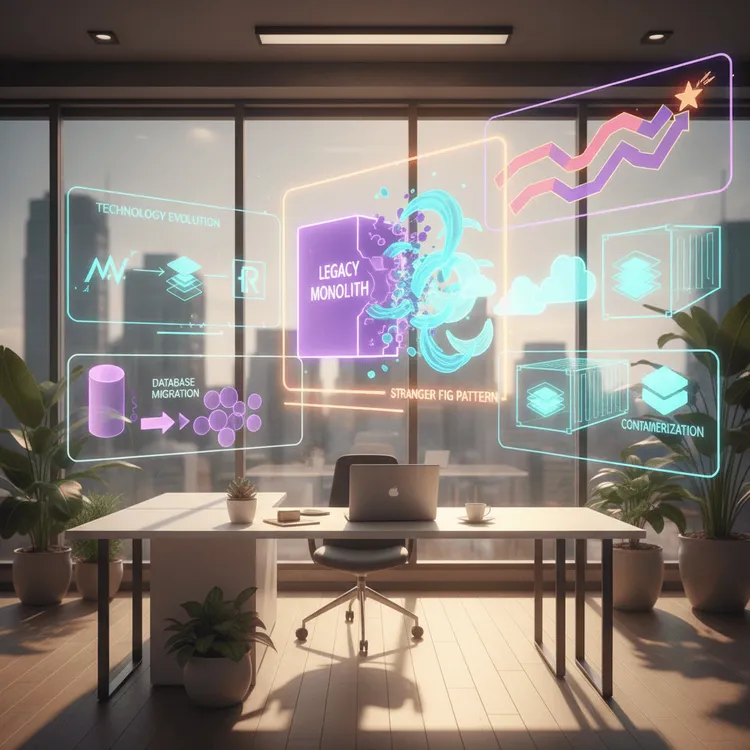

Why Choose MicrocosmWorks for Legacy Modernization?
Legacy systems hold critical business logic but become increasingly expensive to maintain, extend, and staff. We modernize applications incrementally — moving from outdated frameworks and infrastructure to modern stacks without risky big-bang rewrites. Our approach preserves what works while enabling what's next.
Our Legacy Modernization Capabilities
- Assessment & Roadmap — Analyze your legacy system's architecture, dependencies, technical debt, and business criticality to create a prioritized modernization roadmap.
- Strangler Fig Migration — Incrementally replace legacy components with modern services while maintaining system stability throughout the transition.
- Framework Migration — Migrate from jQuery to React, from PHP to Node.js, from monolithic Java to modern microservices, preserving business logic.
- Database Modernization — Migrate from Oracle/SQL Server to PostgreSQL, redesign schemas for modern patterns, and implement proper data access layers.
- Cloud Migration — Move from on-premises or outdated hosting to modern cloud platforms with containers, auto-scaling, and infrastructure as code.
- API Extraction — Extract business logic from tightly-coupled monoliths into clean, documented APIs that enable new frontends and integrations.

Technology Stack
We modernize to battle-tested stacks: React/Next.js for frontends, Node.js/Python for backends, PostgreSQL for databases, Docker/Kubernetes for deployment, and Terraform for infrastructure. Each migration is planned to minimize risk and maximize developer productivity gains.
Who This Is For
Companies with 5-15 year old applications that are becoming expensive to maintain, difficult to hire for, or blocking product innovation. Whether it's a jQuery monolith, a legacy PHP system, or an aging .NET application, we'll chart the path to modern.
Our Process
Discovery & Assessment
Map legacy architecture, identify dependencies, assess risk areas, and establish modernization priorities.
Strategy & Roadmap
Design target architecture, plan migration phases, define success criteria, and estimate effort per phase.
Incremental Migration
Execute strangler fig pattern — build new components alongside legacy, gradually routing traffic to modern services.
Testing & Validation
Comprehensive regression testing, performance benchmarking, and parallel running to ensure feature parity.
Cutover & Decommission
Final migration of remaining components, decommission legacy systems, and optimize the modern platform.
Technology Stack
Modern Frontend
Modern Backend
Database
Infrastructure
Industries We Serve
Ready to Modernize Your Legacy Application?
Let's create a roadmap to transform your legacy system into a modern, maintainable platform.
Frequently Asked Questions
We use the strangler fig pattern, lift-and-shift to cloud, re-platforming, re-architecting to microservices, and incremental rewriting strategies. We assess your application and recommend the approach that balances risk, cost, and business continuity.
Legacy modernization consulting and development at MicrocosmWorks ranges from $20-$45/hour. We start with a thorough assessment to estimate the full scope and create a phased modernization roadmap.
Yes, we use incremental modernization strategies like the strangler fig pattern where new functionality is built in modern technologies alongside the legacy system, gradually migrating traffic with zero downtime and rollback capability.
We implement dual-write patterns and change data capture to keep legacy and modern databases synchronized during the transition period, running both systems in parallel until the migration is validated and the legacy system can be decommissioned.
Yes, we modernize applications from outdated stacks including jQuery, PHP 5, classic ASP, ColdFusion, and legacy Java to modern frameworks like React, Next.js, Laravel, or Spring Boot while preserving business logic and data integrity.