
MicrocosmWorks创新与构建数字宇宙
关于我们联系我们
MicrocosmWorks创新与构建数字宇宙

提供重要的IT解决方案。我们热衷于技术、安全,并通过可靠、创新的IT基础设施帮助企业成长。

[email protected]
+91 7011868196
New Delhi, India

AI增长中心

AI中心初创创新企业加速器

解决方案

所有解决方案健康与健身应用AI视频平台AI代理开发

资源

见解行业指南用例蓝图架构模式案例研究

公司

关于我们联系我们我们的工作

服务

数字咨询云基础设施SaaS 开发AI 开发视频技术
ERP 开发Zoho 定制Odoo 开发Salesforce 集成定制 CRM 开发
QuickBooks 集成物联网解决方案区块链开发
网络安全咨询IT 支持 - L3

© 2026 MicrocosmWorks. 保留所有权利。

隐私政策服务条款
返回洞察
Cloud Solutions

How We Scale Video Processing Workloads with AWS ECS

Scaling containerized video processing on AWS ECS with task definitions, autoscaling, and queue-driven workers.

Untitled (612 x 640 px) (1).webpManya Garg
•
July 24, 2026
•
更新于 July 29, 2026
•
5 min read
ChatGPT Image Jul 29, 2026, 01_57_11 PM (1).webp
5 min read

As our video processing platform grew, so did the complexity of handling compute-intensive workloads. Tasks such as video normalization, audio extraction, transcription, overlay generation, and rendering can consume significant CPU and memory resources, especially when multiple projects are processed simultaneously.

Running these workloads directly within the main application infrastructure can lead to resource contention, slower processing times, and limited scalability. As demand increased, we needed a more flexible and efficient way to manage processing workloads without impacting the performance of our core application services.

To address these challenges, we adopted AWS Elastic Container Service (ECS) as our container orchestration platform.

We can effectively manage background processing activities, scale resources according to demand, and execute processing workloads in separate containers with AWS ECS.This allows our platform to handle varying workloads while maintaining performance, reliability, and operational efficiency.

In this blog, we'll explore what AWS ECS is, why we chose it, and how it helps us scale our video-processing infrastructure.


The Challenge of Scaling Video Processing

Video processing workloads are inherently resource-intensive and highly variable.

A single project may involve:

  • Video normalization
  • Audio extraction
  • Speech-to-text transcription
  • Overlay generation
  • Rendering multiple output variations
  • Processing high-resolution media assets

As the number of projects increases, infrastructure demands can grow rapidly.

We needed a solution that could:

  • Scale processing resources when required
  • Manage several tasks at once
  • Isolate resource-intensive tasks from user-facing services
  • Improve reliability during peak demand
  • Optimize infrastructure utilization
  • Cut down on operational overhead

Traditional approaches that rely solely on long-running servers can become inefficient as workloads grow. We wanted a system that could dynamically allocate resources based on actual demand.


What Is AWS ECS?

AWS Elastic Container Service (ECS) is a fully managed container orchestration service that allows organizations to run and manage containerized applications at scale.

ECS helps automate:

  • Container deployment
  • Task scheduling
  • Resource allocation
  • Service management
  • Workload scaling
  • Health monitoring

Instead of manually managing servers and application processes, ECS provides a centralized platform for running containerized workloads efficiently.


Why We Chose AWS ECS

Scalability on Demand

One of the biggest advantages of ECS is its ability to scale workloads based on demand.

Video-processing requirements can fluctuate significantly throughout the day. Some periods may involve only a few processing jobs, while others may require handling large batches of rendering and media-processing tasks simultaneously.

ECS allows us to dynamically launch additional processing tasks when demand increases and scale down when workloads decrease.

This flexibility helps us maintain performance without permanently allocating unnecessary resources.

Workload Isolation

Tasks involving video processing frequently require a large amount of CPU and memory.

By running workloads in separate containers, ECS enables us to isolate processing operations from our core application services.

This separation helps:

  • Boost the system's stability
  • Steer clear of resource competition
  • Simplify troubleshooting
  • Increase fault tolerance

If a processing task encounters an issue, it does not directly impact the rest of the platform.

Efficient Resource Utilization

Not all processing workloads require the same amount of compute power.

Some operations are lightweight, while others involve intensive rendering and media processing.

ECS allows us to allocate resources based on workload requirements, ensuring that infrastructure resources are used efficiently and effectively.

This helps optimize both performance and operational costs.

Reduced Operational Complexity

Managing large numbers of processing services manually can quickly become difficult.

ECS simplifies infrastructure management by handling:

  • Container scheduling
  • Task execution
  • Health checks
  • Resource management
  • Service recovery

This frees up our technical staff to concentrate on platform enhancement rather than infrastructure upkeep.

Seamless AWS Integration

ECS integrates naturally with other AWS services that are part of our infrastructure.

This enables streamlined deployment, monitoring, security, and operational workflows while maintaining a consistent cloud-native architecture.


How We Use AWS ECS

AWS ECS plays a critical role in our video-processing pipeline.

Rather than running all processing operations directly on our primary application servers, we execute resource-intensive workloads through containerized processing tasks managed by ECS.

Video Normalization

Uploaded videos often require preparation before they can enter downstream workflows.

ECS helps us process these normalization tasks independently, ensuring consistent input formats for subsequent operations.

Audio Extraction and Transcription

Audio extraction and transcription can be computationally intensive, particularly when processing multiple videos simultaneously.

Running these tasks within ECS allows us to scale processing capacity as demand grows.

Rendering Workloads

Video rendering is one of the most resource-intensive stages of our workflow.

By leveraging ECS, we can execute rendering jobs independently and allocate resources specifically for rendering tasks.

This helps maintain consistent performance even during periods of heavy demand.

Background Processing

Many operations occur asynchronously behind the scenes.

Examples include:

  • Media preparation
  • Asset processing
  • Workflow execution
  • Post-processing operations

ECS provides a reliable environment for running these background workloads at scale.


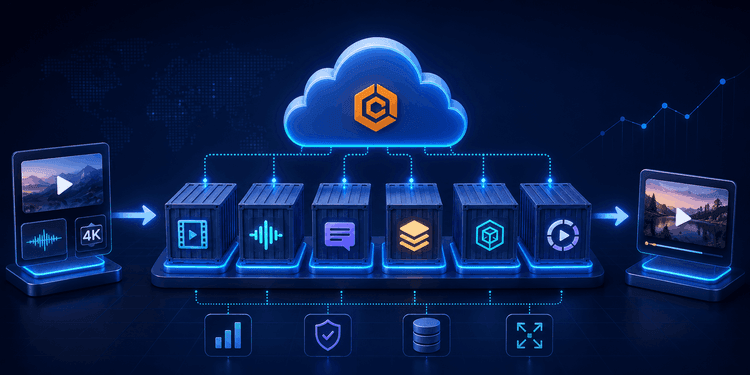
Our Containerized Processing Workflow

A simplified version of our processing workflow looks like this:

Step 1: Project Submission

A user submits a project containing video assets and processing requirements.

Step 2: Task Creation

The platform identifies the required processing operations and generates the appropriate workloads.

Step 3: ECS Task Execution

ECS launches containerized processing tasks with the resources required for each operation.

Step 4: Processing and Rendering

Tasks perform normalization, transcription, rendering, and other processing activities.

Step 5: Completion and Delivery

Once processing is complete, outputs are stored and made available to users.

This workflow allows us to efficiently process workloads while maintaining scalability and reliability.


Benefits for Our Users

The infrastructure decisions we make directly impact the user experience.

By leveraging AWS ECS, we can provide:

Faster Processing

Dynamic resource allocation helps reduce processing and rendering times.

Improved Scalability

The platform can handle growing demand without significant architectural changes.

Consistent Performance

Workload isolation helps maintain platform responsiveness even during peak activity.

Enhanced Reliability

Containerized workloads improve fault tolerance and reduce the impact of processing failures.

Better Resource Efficiency

Resources are allocated based on workload requirements, helping optimize performance and cost.


Looking Ahead

As our platform continues to evolve, processing demands will continue to grow. Supporting larger projects, additional workflows, and increasing user activity requires infrastructure that can scale efficiently.

AWS ECS provides the flexibility and orchestration capabilities needed to support these evolving requirements. By continuing to leverage containerized processing workloads, we can adapt to changing demands while maintaining performance, reliability, and operational efficiency.


Conclusion

Scaling video-processing workloads requires infrastructure that can efficiently handle resource-intensive operations while remaining flexible and reliable.

AWS ECS enables us to run and manage containerized workloads at scale, providing the orchestration, scalability, and workload isolation needed to support modern video-processing pipelines. 

By leveraging ECS as a key part of our architecture, we can process workloads more efficiently, improve system reliability, and continue delivering a high-performance experience for our users as our platform grows.

AWSECSContainersScaling
Untitled (612 x 640 px) (1).webp

关于作者

Manya Garg

AI & Cloud Solutions Expert at MicrocosmWorks

Building innovative AI-powered solutions and helping businesses transform through cutting-edge technology.

想了解更多?

联系我们,讨论如何帮助您的业务实施这些解决方案。

联系我们

Comments (0)

Share your thoughts and join the conversation

Leave a Comment

Your email will not be published

No comments yet

Be the first to share your thoughts!