Decouple everything. Let services communicate through events, not expectations about each other's uptime.

Your monolith is becoming a deployment bottleneck — every change requires coordinating across teams, and a bug in billing takes down the entire application. Or you're building a new system where different capabilities evolve at different rates: order management changes weekly, but inventory logic changes quarterly. You need services that can be developed, deployed, and scaled independently, communicating through events rather than synchronous API calls that create cascading failure chains.

Explore more design patterns and system architectures
Nuestros arquitectos pueden ayudarle a diseñar y construir sistemas utilizando este patrón para sus requisitos específicos.
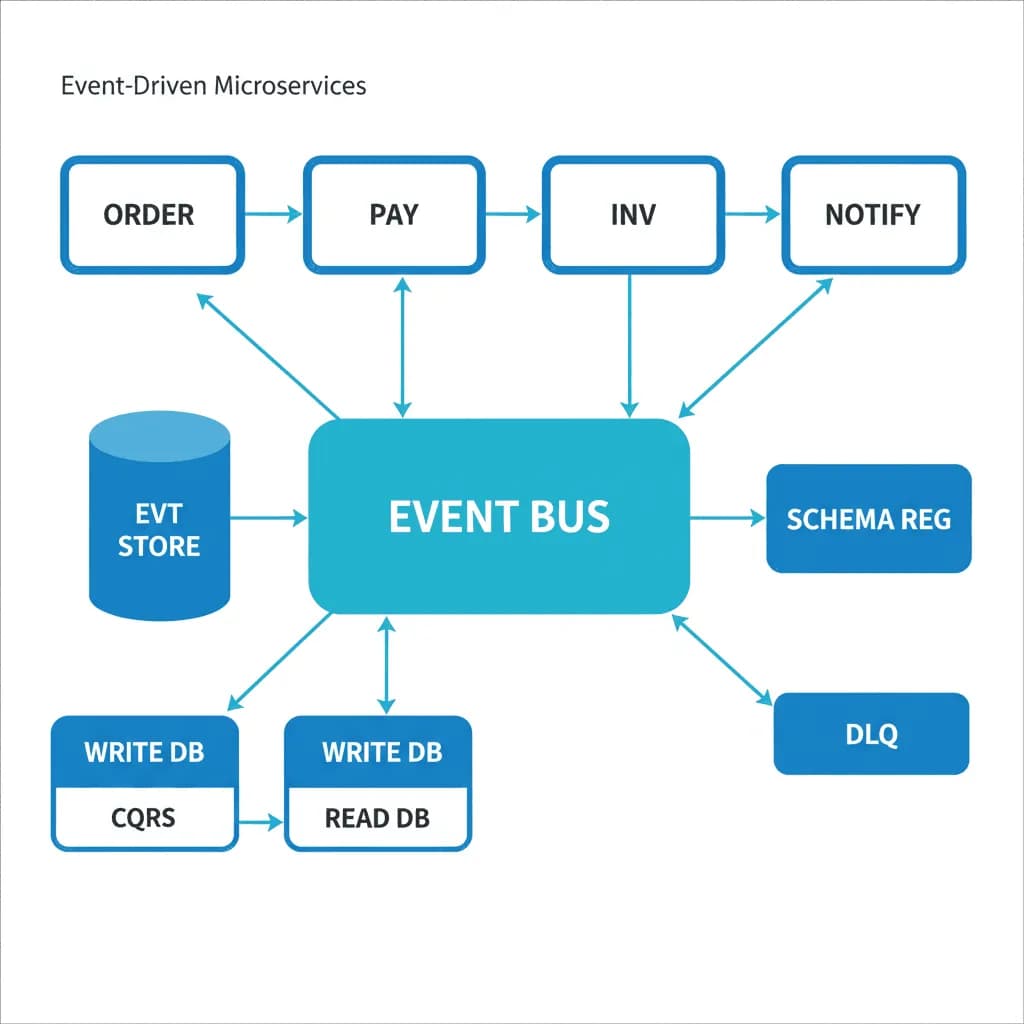
Ponte en ContactoEvent-driven microservices decompose a system into independently deployable services that communicate primarily through asynchronous events. Each service owns its data, publishes domain events when state changes, and reacts to events from other services. This eliminates temporal coupling — Service A doesn't need Service B to be running to do its work. The pattern incorporates CQRS (Command Query Responsibility Segregation) to separate write and read models, event sourcing to capture the full history of state changes, and saga orchestration to manage multi-service transactions without distributed locks.

The architecture centers on an event backbone (Kafka, EventBridge, or NATS) that routes domain events between services. Each service has three boundaries: a command handler that processes incoming requests and emits events, a query handler that serves read-optimized projections, and an event processor that reacts to events from other services. A saga orchestrator coordinates multi-step business processes (e.g., order fulfillment) by listening for events and issuing compensating commands when steps fail.

System Architecture Overview
| Layer | Technologies |
|---|---|
| Compute | Node.js (NestJS), Python (FastAPI), Go — per service based on workload characteristics |
| Messaging | Apache Kafka (MSK), AWS EventBridge, NATS JetStream, RabbitMQ |
| Data | PostgreSQL (transactional), DynamoDB (key-value), Redis (caching/locks), EventStoreDB |
| Orchestration | Temporal (workflow orchestration), AWS Step Functions, custom saga coordinator |
| Observability | OpenTelemetry (distributed tracing), Datadog, Jaeger, structured logging with correlation IDs |
| Use When | Avoid When |
|---|---|
| Multiple teams need to deploy independently on different cadences | Your team is < 5 engineers — a well-structured monolith is simpler to operate |
| Different parts of the system have different scaling characteristics | You're building an MVP and need to ship fast — distributed systems are slow to build |
| You need strong audit trails and event replay capabilities | Every operation requires synchronous, strongly consistent responses |
| The domain has natural bounded contexts (orders, payments, inventory) | The domain is tightly coupled — splitting it creates a distributed monolith |
MW doesn't decompose into microservices by technical layer (API service, data service, auth service). We decompose along domain boundaries using DDD (Domain-Driven Design) bounded contexts. Before writing code, we run an event storming workshop to map domain events, commands, and aggregates — this determines service boundaries, not technology preferences. We've migrated monoliths to event-driven architectures for enterprise clients, and the most common lesson is: start with fewer, larger services and split later, not the other way around.
Los modelos no se ejecutan solos. El pipeline que entrena, valida, despliega y monitorea tus modelos es el producto real — el modelo es solo un artefacto.
MicrocosmWorks designs event-driven systems with durable message brokers like Apache Kafka or Amazon EventBridge that retain events until consumers successfully process them, ensuring no data loss during outages. We implement dead-letter queues, exponential backoff retry policies, and circuit breakers so that a failing microservice does not block the entire event pipeline. Once the downstream service recovers, it automatically catches up on unprocessed events without manual intervention.
Event-driven communication is the better choice when your services do not need an immediate response, when you need to decouple deployment cycles, or when a single action triggers multiple downstream processes. MicrocosmWorks typically recommends event-driven patterns for order processing, notification pipelines, and analytics ingestion, while keeping synchronous APIs for user-facing queries that require sub-second responses. Many production systems we build use a hybrid approach with synchronous reads and asynchronous writes.
MicrocosmWorks uses partition-key-based ordering in Kafka topics to guarantee that all events for a given entity (like a specific order or user) are processed sequentially by the same consumer instance. For scenarios requiring cross-entity ordering, we implement saga orchestrators with idempotent event handlers that can safely reprocess out-of-order messages. We also embed vector clocks or sequence numbers in event payloads so consumers can detect and reconcile ordering conflicts.
MicrocosmWorks implements the Saga pattern with compensating transactions, where each microservice publishes domain events after completing its local transaction, and downstream services react accordingly or trigger rollback compensations on failure. We combine this with an outbox pattern that atomically writes events to a local outbox table alongside business data, then reliably publishes them to the message broker. This achieves eventual consistency without the performance and reliability penalties of two-phase commits.
MicrocosmWorks instruments every event with correlation IDs and distributed tracing headers using OpenTelemetry, which lets us visualize the complete lifecycle of a business transaction across all participating microservices in tools like Jaeger or Grafana Tempo. We also build real-time event flow dashboards that show throughput, consumer lag, and processing latency per service, making it easy to pinpoint bottlenecks. Our standard observability stack includes structured logging with event metadata so that any single event can be traced from producer to every consumer in seconds.