Back to Architecture Patterns

InfrastructureEnterprise

Cloud-Native Infrastructure

Infrastructure that's versioned, tested, and deployed like application code — because your platform is only as reliable as what's underneath it.

May 2, 2026
|
2 topics covered
Discuss This Architecture
Cloud-Native Infrastructure
Infrastructure
Category
Enterprise
Complexity
Enterprise SaaS, Financial Services
Industries
2+
Technologies

When You Need This

Your infrastructure is managed by clicking through cloud consoles. Environment drift between staging and production causes "works on my machine" issues at the infrastructure level. Scaling requires manual intervention, deployments involve SSH-ing into servers, and disaster recovery is a Google Doc that nobody has tested. You need infrastructure that's reproducible, version-controlled, self-healing, and observable — infrastructure that a team can operate without hero knowledge.

Pattern Overview

Cloud-native infrastructure treats infrastructure as code (IaC), runs workloads in containers orchestrated by Kubernetes (or managed equivalents), deploys through GitOps pipelines, and uses managed services where the operational trade-off is favorable. The pattern covers multi-region deployment for availability, horizontal pod autoscaling for elasticity, service mesh for inter-service communication, and comprehensive observability. The goal isn't "running on cloud" — it's building infrastructure that's automated, reproducible, and resilient by default.

Reference Architecture

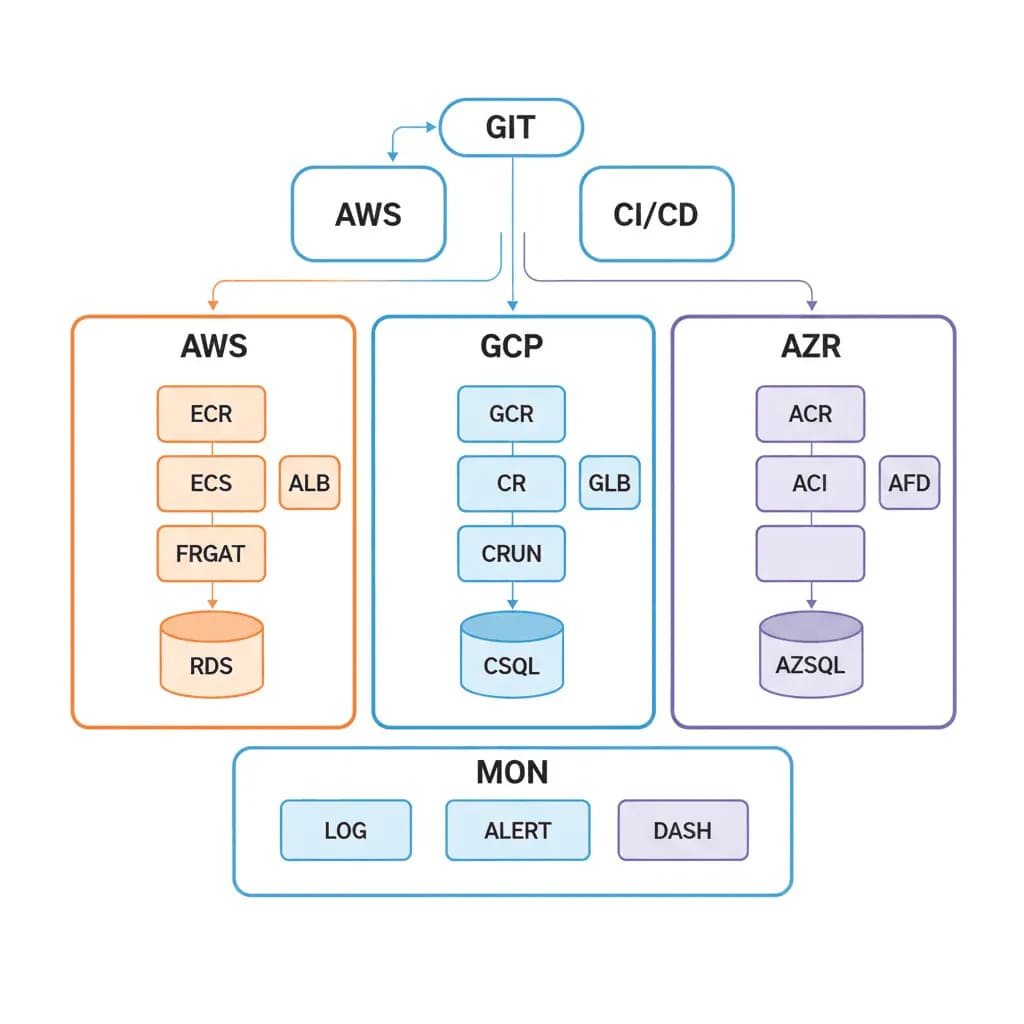
The architecture spans three planes. The control plane manages infrastructure provisioning through Terraform/Pulumi, runs GitOps controllers (ArgoCD/Flux), and handles secrets management (Vault/AWS Secrets Manager). The workload plane runs application containers in Kubernetes clusters (EKS, GKE, or AKS) with pod autoscaling, service mesh (Istio/Linkerd), and ingress management. The observability plane collects metrics (Prometheus), logs (Loki/CloudWatch), traces (Jaeger/Datadog), and alerts (PagerDuty/OpsGenie).

Core Components
  • IaC Foundation: Terraform or Pulumi modules that define every resource — VPCs, subnets, security groups, IAM roles, databases, caches, queues. Modularized by concern (networking, compute, data, observability) with environment-specific variable files
  • Kubernetes Cluster: Multi-AZ deployment with node pools sized for workload types (general, compute-optimized, GPU). Namespace-per-environment or namespace-per-team isolation. Pod disruption budgets, resource quotas, and network policies
  • GitOps Pipeline: ArgoCD or Flux watches a Git repository for manifests. Application deployments are pull requests — reviewed, approved, and automatically synced. Rollback is a git revert
  • Observability Stack: Prometheus + Grafana for metrics, Loki or ELK for logs, Jaeger or Datadog for distributed tracing. SLO-based alerting that pages on customer impact, not resource utilization

Design Decisions & Trade-offs

EKS vs. GKE vs. AKS
MW picks the platform that fits the existing cloud footprint. GKE has the best Kubernetes experience (Autopilot is genuinely hands-off). EKS is the pragmatic choice for AWS-heavy organizations. AKS for Azure shops. We don't recommend multi-cloud Kubernetes unless there's a genuine business requirement (regulatory, vendor risk). The operational overhead of managing clusters across clouds rarely justifies the flexibility.
Terraform vs. Pulumi
Terraform for teams that want a large ecosystem, mature providers, and HCL's declarative model. Pulumi for teams that prefer programming languages (TypeScript, Python) over DSLs. MW uses both — Terraform for shared infrastructure modules, Pulumi when complex logic (conditional resources, loops, API calls during provisioning) makes HCL unwieldy.
Managed Services vs. Self-Hosted
MW defaults to managed services (RDS over self-hosted PostgreSQL, MSK over self-hosted Kafka, ElastiCache over self-hosted Redis) unless: (a) the managed service has a hard limitation you'll hit, (b) the cost at your scale makes self-hosted economical (typically >$50K/month on managed), or (c) regulatory requirements demand it. The ops burden of self-hosting is almost always underestimated.
Service Mesh: Yes or No
A service mesh (Istio, Linkerd) adds mTLS, traffic management, and observability between services — but also adds latency, complexity, and another thing to debug. MW recommends a service mesh when you have >10 services, need mutual TLS for compliance, or want canary deployments at the network level. For smaller systems, application-level retries and circuit breakers (via libraries) are simpler.
Cloud-Native Infrastructure - System Architecture Diagram

System Architecture Overview

Technology Choices

LayerTechnologies
ComputeKubernetes (EKS, GKE, AKS), ECS Fargate, Cloud Run
IaCTerraform, Pulumi, AWS CDK
GitOpsArgoCD, Flux, GitHub Actions
NetworkingIstio, Linkerd, AWS App Mesh, Nginx Ingress, Cert-Manager
ObservabilityPrometheus, Grafana, Datadog, Loki, Jaeger, PagerDuty

When to Use / When to Avoid

Use WhenAvoid When
Running 5+ services that need independent scaling and deploymentYou have a single application that can run on a PaaS (Vercel, Railway, Render)
Multiple teams contribute to shared infrastructureYour team is < 3 engineers — Kubernetes operational burden will dominate
You need multi-region deployment for availability or complianceThe project is an MVP that doesn't need HA or complex orchestration
Compliance requires reproducible, auditable infrastructureCost optimization is critical and the workload fits serverless economics

Our Approach

MW delivers infrastructure as a product, not a one-time setup. We provide Terraform modules with CI/CD pipelines that plan, review, and apply infrastructure changes through pull requests — the same workflow your developers use for application code. Our Kubernetes deployments include production-grade defaults: pod disruption budgets, resource limits, network policies, and automated certificate rotation. We hand off with operational runbooks, Grafana dashboards, and on-call escalation policies so your team can operate the infrastructure independently.

Related Blueprints

Related Case Studies

Related Technologies
Cloud SolutionsDigital Consulting

Need Help Implementing This Architecture?

Our architects can help design and build systems using this pattern for your specific requirements.

Get In Touch


Contact UsSchedule Appointment