Back to Architecture Patterns

AI / DataEnterprise

AI/ML Pipeline Architecture

Models don't run themselves. The pipeline that trains, validates, deploys, and monitors your models is the actual product — the model is just one artifact.

May 2, 2026
|
3 topics covered
Discuss This Architecture
AI/ML Pipeline Architecture
AI / Data
Category
Enterprise
Complexity
Healthcare, Financial Services
Industries
3+
Technologies

When You Need This

You've proven an ML model works in a notebook. Now you need it in production — serving predictions at scale, retraining on new data, monitoring for drift, and rolling back when a new model performs worse than the current one. The gap between a working prototype and a production ML system is enormous. You need a pipeline that handles data ingestion, feature engineering, training, validation, deployment, and monitoring as a repeatable, automated process. Without this, your "AI product" is a notebook that a data scientist reruns manually every week.

Pattern Overview

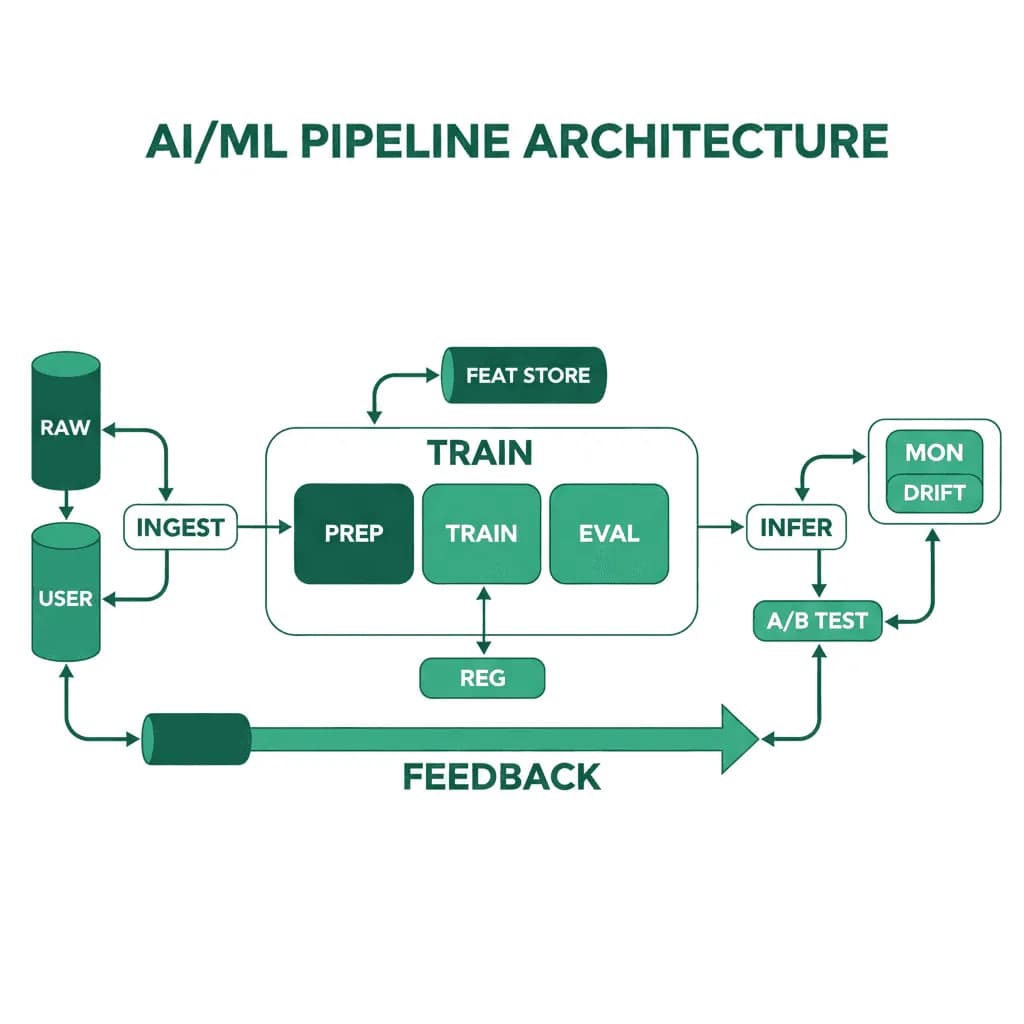
AI/ML pipeline architecture separates the ML lifecycle into distinct, automated stages: data ingestion and validation, feature engineering and storage, model training and hyperparameter tuning, model evaluation and validation, model serving and inference, and continuous monitoring. Each stage is versioned, reproducible, and observable. The architecture supports both batch (scheduled retraining) and online (real-time feature computation) workflows. A feature store decouples feature engineering from model training, enabling feature reuse across models and consistent features between training and serving.

Reference Architecture

The pipeline flows from data sources (databases, APIs, event streams) through a feature engineering layer that computes and stores features in a feature store (online for serving, offline for training). A training orchestrator runs experiments, logs parameters and metrics, and produces versioned model artifacts stored in a model registry. A deployment pipeline promotes models through staging to production with automated canary evaluation. Model serving runs behind a load balancer with A/B testing support. A monitoring layer tracks prediction drift, data drift, and business metrics to trigger retraining.

Core Components
  • Feature Store: Dual-mode store with an offline component (Parquet/Delta Lake on S3) for training and an online component (Redis/DynamoDB) for low-latency serving. Features are defined once and computed consistently for both training and inference, eliminating the training-serving skew that causes most production ML bugs
  • Training Orchestrator: Manages training runs with experiment tracking (MLflow, W&B), hyperparameter optimization (Optuna, Ray Tune), and distributed training for large models (PyTorch DDP, Horovod). Outputs versioned model artifacts with metadata (training data hash, hyperparameters, metrics)
  • Model Registry & Deployment: Central registry (MLflow Model Registry, SageMaker Model Registry) that tracks model versions, approval status, and deployment history. CI/CD pipeline that deploys models as containers (TorchServe, Triton, custom Flask/FastAPI) with canary rollout and automated rollback
  • Monitoring & Drift Detection: Tracks input data distribution (data drift), prediction distribution (prediction drift), and business metrics (conversion rate, accuracy on labeled samples). Automated alerts when drift exceeds thresholds, with optional automatic retraining triggers

Design Decisions & Trade-offs

Feature Store: Build vs. Buy
Feast (open source) works for teams starting out and needing basic online/offline feature serving. Tecton or SageMaker Feature Store for teams that need managed infrastructure and point-in-time correctness guarantees. MW recommends Feast for most engagements — it's deployable anywhere, avoids vendor lock-in, and handles the 80% use case. We upgrade to managed options when feature engineering complexity or team size warrants it.
Batch Retraining vs. Online Learning
Batch retraining (scheduled, full-pipeline re-run) is simpler, debuggable, and sufficient for most use cases where the world changes slowly (weekly/monthly). Online learning (model updates with each new data point) is required only when the distribution shifts rapidly (fraud detection, real-time recommendation). MW defaults to batch retraining with scheduled pipelines and adds online learning only when the latency between world-change and model-update is a measurable business problem.
Model Serving: Real-Time vs. Batch Inference
Real-time serving (REST/gRPC endpoint, <100ms latency) for user-facing predictions — recommendations, classification, NLP. Batch inference (scheduled job that scores a dataset) for internal analytics, risk scoring, or precomputation. MW sizes serving infrastructure based on P99 latency requirements and throughput, not average load — ML serving has high variance.
GPU vs. CPU for Inference
CPU inference is cheaper and simpler to scale for most models (gradient-boosted trees, small neural networks, traditional NLP). GPU inference for large models (LLMs, computer vision, speech-to-text) where the batch processing advantage of GPU parallelism justifies the cost. MW profiles inference latency on both and makes an economic case — many teams default to GPU inference and overspend by 5x.
AI/ML Pipeline Architecture - System Architecture Diagram

System Architecture Overview

Technology Choices

LayerTechnologies
TrainingPyTorch, TensorFlow, scikit-learn, XGBoost, Hugging Face Transformers
OrchestrationKubeflow, SageMaker Pipelines, Airflow, Prefect, Dagster
Feature StoreFeast, Tecton, SageMaker Feature Store
Model ServingTorchServe, Triton Inference Server, SageMaker Endpoints, FastAPI
Experiment TrackingMLflow, Weights & Biases, Neptune
MonitoringEvidently AI, WhyLabs, custom Prometheus metrics

When to Use / When to Avoid

Use WhenAvoid When
You have ML models in production that need regular retrainingYou're still exploring whether ML solves the problem — start with notebooks
Multiple models share features and need consistent feature engineeringYou have one model retrained quarterly — a script and cron job may suffice
You need reproducible training with versioned data, code, and modelsThe ML component is a single API call to a hosted LLM (use AI SDK patterns instead)
Model performance degradation directly impacts business metricsThe team doesn't have ML engineering skills to operate the pipeline

Our Approach

MW builds ML pipelines with a "production-first" mindset — we start with the serving and monitoring infrastructure before optimizing the model. A mediocre model in a robust pipeline beats a great model in a notebook. Our pipelines include automated data validation (Great Expectations), training-serving skew tests, shadow mode deployment (new model receives traffic but doesn't serve results), and gradual rollout with automatic rollback on metric regression. We've deployed pipelines handling 50M+ predictions/day across healthcare, fintech, and computer vision domains.

Related Blueprints

Related Case Studies

Related Technologies
AI DevelopmentCloud SolutionsDigital Consulting

Need Help Implementing This Architecture?

Our architects can help design and build systems using this pattern for your specific requirements.

Get In Touch


Contact UsSchedule Appointment