MicrocosmWorks디지털 코스모스 혁신 및 설계
소개연락처
MicrocosmWorks디지털 코스모스를 혁신하고 설계합니다

중요한 IT 솔루션을 제공합니다. 기술, 보안에 열정적이며 신뢰할 수 있는 혁신적인 IT 인프라를 통해 비즈니스 성장을 돕습니다.

[email protected]
+91 7011868196
New Delhi, India

AI 성장 허브

AI 허브스타트업 혁신기업 가속기

솔루션

모든 솔루션웰니스 및 피트니스 앱AI 비디오 플랫폼AI 에이전트 개발

자원

통찰력산업 가이드사용 사례 청사진아키텍처 패턴사례 연구

회사

회사 소개연락처우리의 작업

서비스

디지털 컨설팅클라우드 인프라SaaS 개발AI 개발비디오 기술
ERP 개발Zoho 맞춤화Odoo 개발Salesforce 통합맞춤형 CRM 개발
QuickBooks 통합IoT 솔루션블록체인 개발
사이버 보안 컨설팅IT 지원 - L3

© 2026 MicrocosmWorks. 모든 권리 보유.

개인정보 처리방침서비스 약관
통찰로 돌아가기
AI Development

Building Reliable Timezone-Aware Push Notification Systems

Designing a push notification system that fires at the right local time for every user, reliably.

Mayank Joshi.webpMayank Chandra Joshi
•
July 31, 2026
•
수정일 July 31, 2026
•
5 min read
ChatGPT Image Jul 31, 2026, 12_37_55 PM (1).webp
5 min read

Building a Reliable, Timezone-Aware Push Notification System

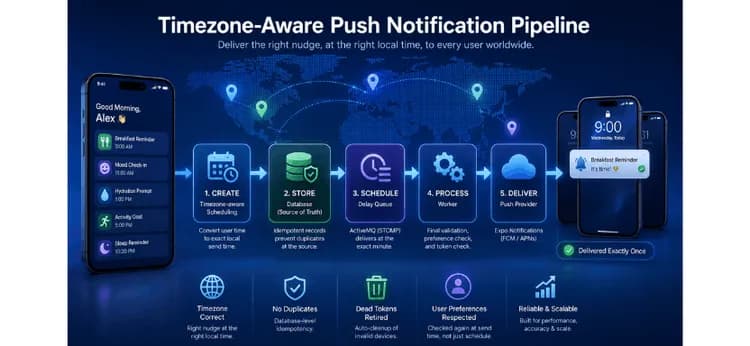
A health & wellness app needed to send personalized daily nudges — meal reminders, mood check-ins, hydration prompts, sleep cues, and custom reminders — to thousands of users across the globe. The catch: every notification had to arrive at the right local time, exactly once, and never to a dead device. We designed and built the distributed pipeline that makes that happen.


The Challenge

  • Timezone correctness at scale. A "9 AM breakfast reminder" means something different for every user. Sending in server time would ping someone in Sydney at 3 AM. Each notification needed to resolve to the user's local moment.
  • No spam, no duplication. Scheduling crons inevitably overlap and re-run. Without strict guarantees, a single user could receive the same "time for lunch 🥗" nudge two or three times — a fast track to an uninstall.
  • Devices are unreliable. Users uninstall apps, revoke permissions, and rotate push tokens constantly. Firing notifications blindly at stale tokens wastes resources and corrupts delivery metrics.
  • Precise timing without a brute-force scheduler. Delivering hundreds of notifications at exact minutes — without a cron hammering the database every 60 seconds — required a smarter mechanism than naive polling.


Our Solution

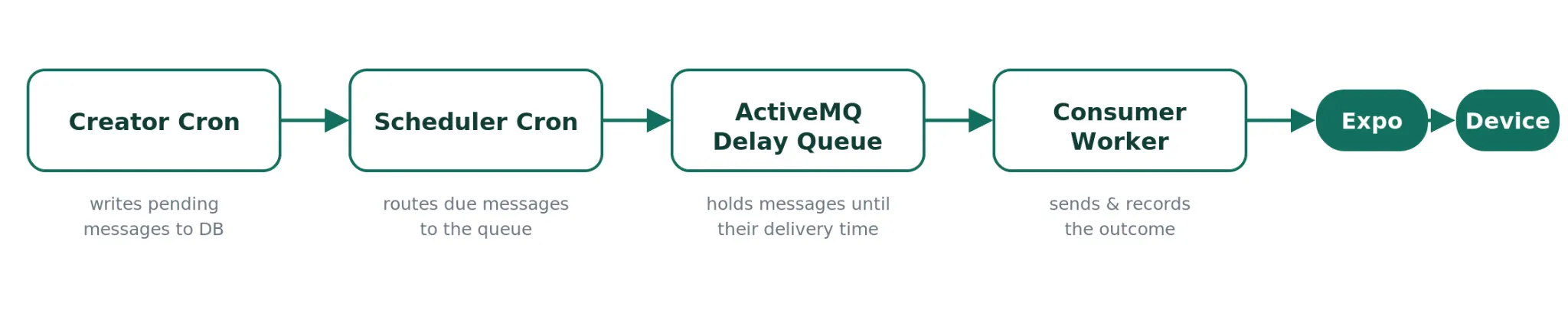
We built a three-stage pipeline that cleanly separates what to send, when to send it, and actually sending it — so each stage can fail and recover independently. The database is the source of truth, a message queue handles precise timing, and a single worker layer talks to the push provider.

image.webp


Architecture

  • Expo-notifications is a React Native client with native channels, unique noises, and deep links that uses a single token format and delivery API for both iOS and Android.
  • NestJS backend with expo-server-sdk as the unified push abstraction over FCM and APNs.
  • MongoDB as the source of truth — NotificationMessage, NotificationToken, and NotificationCounter collections.
  • ActiveMQ (STOMP) delay queues, one per category (meal, mood, activity, safety, reminders), for precise scheduled delivery.
  • Creator crons that generate timezone-resolved notification records per user.
  • Consumer workers that subscribe to each queue and perform final validation before sending.
  • AWS ECS Fargate running crons and consumers; ActiveMQ on a dedicated EC2 instance.


Key Features

  1. Timezone-aware scheduling. Using date-fns-tz, each user's local send time is computed, converted back to UTC for storage, and bounded by UTC date windows to guarantee one nudge per day.
  2. Database-enforced idempotency. A partial unique index on pending messages makes duplicate creation impossible — even when a cron runs twice:
// Unique only while the message is still PENDING and not deleted

schema.index(

  { userId: 1, notificationTokenId: 1, category: 1, label: 1, scheduledAt: 1 },

  { unique: true, partialFilterExpression: { status: 'pending', isDeleted: false } }

);


3. Precise delivery via delay queues. Instead of a per-minute cron, the scheduler enqueues messages now but defers delivery to the exact due minute using ActiveMQ's scheduled-delay header:
 

client.send(`/queue/${queueName}`, {

  persistent: 'true',

  'AMQ_SCHEDULED_DELAY': String(delayMs), // delivered exactly when due

}, JSON.stringify(message));


4. Single active token per device. A partial unique index guarantees exactly one active token per device; new logins cleanly retire the old token, with exponential-backoff retries to survive concurrent sign-ins.

5. Receipt checking + auto-cleanup. After sending, we poll Expo receipts. A DeviceNotRegistered response immediately deactivates the dead token so we never waste a send on it again.

f (receipt.status === 'error' &&

    receipt.details?.error === 'DeviceNotRegistered') {

  await this.deactivateToken(token); // stop sending to dead devices

}


6. Failure ceiling. Each device has a retry counter; after 3 consecutive failures the token is automatically retired — no infinite loops, no zombie tokens.

7. Respecting user intent at send time. Notification preference is re-checked by the consumer at delivery, not just at scheduling — so a user who opts out an hour before a nudge never receives it. Messages resolve to honest terminal states: success, failed, or is_missed.


Results

  • Every user receives nudges at the correct local time, worldwide — zero off-hours notifications.
  • Duplicate notifications eliminated entirely through database-level idempotency.
  • Dead and stale device tokens are detected and retired automatically, keeping delivery clean.
  • Reliability is increased and database load is reduced with precise, minute-accurate delivery without a brute-force scheduler.


Technology Stack

React Native · Expo Notifications · NestJS · TypeScript · MongoDB · ActiveMQ (STOMP) · expo-server-sdk · date-fns-tz · AWS ECS Fargate

Push NotificationsTimezonesSchedulingReliability
Mayank Joshi.webp

저자 소개

Mayank Chandra Joshi

AI & Cloud Solutions Expert at MicrocosmWorks

Building innovative AI-powered solutions and helping businesses transform through cutting-edge technology.

더 자세히 알고 싶으신가요?

비즈니스를 위한 이러한 솔루션 구현 방법에 대해 문의하세요.

연락하기

Comments (0)

Share your thoughts and join the conversation

Leave a Comment

Your email will not be published

No comments yet

Be the first to share your thoughts!