MicrocosmWorks创新与构建数字宇宙
关于我们联系我们
MicrocosmWorks创新与构建数字宇宙

提供重要的IT解决方案。我们热衷于技术、安全,并通过可靠、创新的IT基础设施帮助企业成长。

[email protected]
+91 7011868196
New Delhi, India

AI增长中心

AI中心初创创新企业加速器

解决方案

所有解决方案健康与健身应用AI视频平台AI代理开发

资源

见解行业指南用例蓝图架构模式案例研究

公司

关于我们联系我们我们的工作

服务

数字咨询云基础设施SaaS 开发AI 开发视频技术
ERP 开发Zoho 定制Odoo 开发Salesforce 集成定制 CRM 开发
QuickBooks 集成物联网解决方案区块链开发
网络安全咨询IT 支持 - L3

© 2026 MicrocosmWorks. 保留所有权利。

隐私政策服务条款
返回架构模式
AI / DataEnterprise

Scalable Vector Database Architecture

Embedding search is easy at 10K vectors. At 100M vectors with sub-100ms P99, it's an infrastructure problem — and that's what this pattern solves.

June 18, 2026
|
2 topics covered
讨论此架构
scalable-vector-database-architecture.webp
AI / Data
Category
Enterprise
Complexity
AI/ML, E-Commerce
Industries
2+
Technologies

When You Need This

Your RAG pipeline or recommendation system works beautifully in development with a few thousand vectors. Now you have 50 million embeddings, queries need sub-100ms latency, the index keeps growing, and you're burning through memory. You need a vector database architecture that scales horizontally, manages memory efficiently (not everything needs to live in RAM), handles concurrent writes during ingestion without degrading query performance, and doesn't cost $10K/month in infrastructure for what is fundamentally a search index.

Related Architecture Patterns

Explore more design patterns and system architectures

rag-pipeline-architecture.webp
AI / Data

RAG 流水线架构

让您的 LLM 无需微调即可访问您的数据。RAG 弥合了通用语言模型与领域特定知识之间的鸿沟。

AdvancedView
ai-ml-pipeline-architecture.webp

需要帮助实现此架构吗?

我们的架构师可以帮助您根据您的具体要求设计和构建使用此模式的系统。

联系我们

Pattern Overview

Scalable vector database architecture addresses the challenges of operating vector search at production scale: index partitioning across nodes (sharding), tiered storage (hot segments in memory, warm on SSD, cold on S3), query routing with load balancing, and autoscaling based on query load and index size. The pattern covers deployment topology, capacity planning, write/read isolation, and cost optimization. It's the infrastructure layer that makes RAG and recommendation systems viable at scale.

Reference Architecture

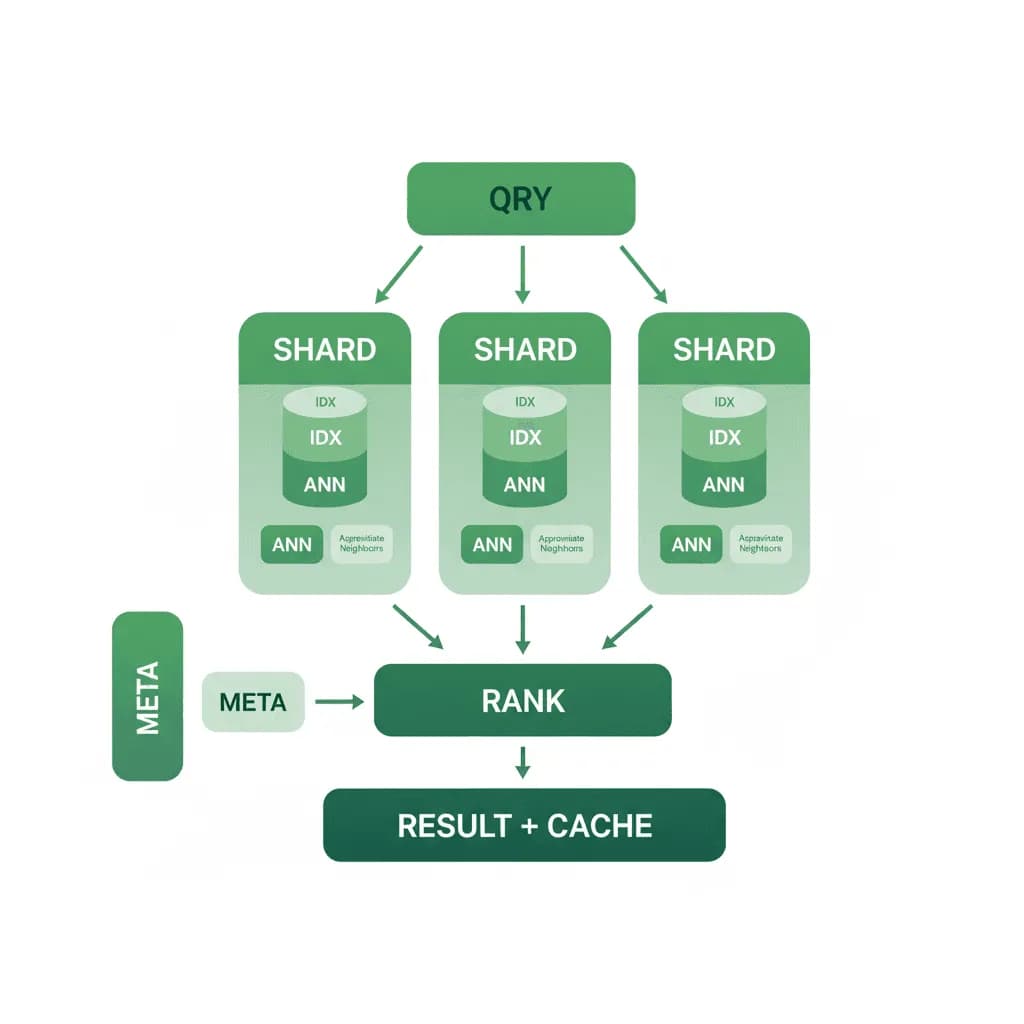
The architecture deploys vector database nodes in a clustered topology with separation between query nodes (read path) and data nodes (write path). An ingestion pipeline handles embedding generation and batch upserts with write buffering to avoid impacting query latency. A query router distributes searches across read replicas with shard-level parallelism. Tiered storage moves infrequently accessed segments from memory to SSD to S3, with transparent query-time loading. Autoscaling adjusts replica count based on query QPS and P99 latency.

Core Components
  • Cluster Management: Milvus (our default for scale) with etcd for metadata coordination, MinIO/S3 for segment storage, and Pulsar/Kafka for write-ahead logging. Alternatively, managed services (Pinecone, Zilliz Cloud) when operational simplicity outweighs cost
  • Shard & Partition Strategy: Logical partitions aligned to data boundaries (per-tenant, per-document-collection, per-time-window). Each partition is independently searchable, enabling filtered queries without scanning the full index. Shards distributed across nodes for parallel query execution
  • Tiered Storage Engine: Hot tier (in-memory HNSW/IVF index) for frequently queried collections. Warm tier (memory-mapped SSD) for large collections with moderate query load. Cold tier (S3-backed) for archival collections that are searchable but tolerate higher latency. Segment-level promotion/demotion based on access patterns
  • Autoscaling Controller: Horizontal pod autoscaler (HPA) on Kubernetes that scales query nodes based on QPS and P99 latency metrics. Scale-up on latency breach, scale-down on sustained low utilization. Separate scaling for ingestion workers to handle burst uploads without affecting query performance

Design Decisions & Trade-offs

Milvus vs. Pinecone vs. Qdrant vs. pgvector
pgvector is fine for < 1M vectors where you already have PostgreSQL and can tolerate ~200ms latency. Pinecone for teams that want zero operational burden and can accept the pricing (scales well but gets expensive past 10M vectors). Qdrant for a clean API with good single-node performance. Milvus for serious scale — it's the only open-source option with true distributed architecture, tiered storage, and production-grade sharding. MW defaults to Milvus for >5M vectors and Pinecone for teams that prioritize managed simplicity.
HNSW vs. IVF_FLAT vs. IVF_PQ
HNSW (Hierarchical Navigable Small World) gives the best recall at low latency but uses the most memory (full vectors in RAM). IVF_FLAT clusters vectors and searches only relevant clusters — good balance of speed and memory. IVF_PQ (Product Quantization) compresses vectors for massive memory savings but reduces recall by 3-8%. MW uses HNSW for collections under 10M vectors and switches to IVF_PQ with PQ refinement (re-score top candidates against full vectors) for larger collections where memory cost matters.
Write Isolation
Concurrent writes during ingestion degrade query latency in most vector databases. MW separates the write path: new vectors are buffered in a write-ahead log, periodically flushed into sealed segments, and merged into the searchable index during low-traffic windows. For systems requiring real-time ingestion (e.g., live document processing), we deploy separate ingestion and query node pools with different resource allocations.
Cost Optimization
Vector databases are memory-hungry. A 100M-vector collection with 1536-dimensional embeddings needs ~600GB of RAM in HNSW mode. MW optimizes cost through: (a) dimensionality reduction where feasible (Matryoshka embeddings, PCA), (b) quantization (scalar or product quantization), (c) tiered storage to push cold segments off RAM, and (d) right-sizing embedding dimensions — 768 dimensions is often sufficient when 1536 is overkill.
Scalable Vector Database Architecture - System Architecture Diagram

System Architecture Overview

Technology Choices

LayerTechnologies
Vector DatabaseMilvus (distributed), Qdrant (single-node/small-cluster), Pinecone (managed)
Storage BackendMinIO / S3 (segment storage), SSD (warm tier), RAM (hot tier)
Coordinationetcd (Milvus metadata), Pulsar/Kafka (write-ahead log)
Embedding ModelsOpenAI text-embedding-3-large, Cohere embed-v4, BGE-M3, E5-large-v2
InfrastructureKubernetes (EKS/GKE) with GPU nodes for embedding, memory-optimized nodes for query
MonitoringGrafana + Milvus metrics exporter, custom P99/recall dashboards

When to Use / When to Avoid

Use WhenAvoid When
Vector count exceeds 5M and growing, requiring horizontal scalingYou have < 1M vectors — pgvector on your existing PostgreSQL is sufficient
Sub-100ms P99 query latency is a hard requirementQuery latency of 500ms+ is acceptable — simpler options work
Multiple applications/tenants share the vector infrastructureA single application with a single collection — use a managed service
Cost optimization requires tiered storage (not everything in RAM)Budget allows fully managed services and the vendor's pricing works at your scale

Our Approach

MW designs vector database infrastructure with a "right-size from day one, scale when measured" approach. We start with capacity planning based on vector count, dimensionality, index type, and target latency — not guesswork. Our Milvus deployments on Kubernetes include Grafana dashboards tracking segment count, memory utilization, query latency percentiles, and recall estimates. We've implemented autoscaling Milvus clusters that handle 10x traffic spikes during business hours and scale down overnight, reducing infrastructure cost by 40-60% compared to static provisioning.

Related Blueprints

  • AI Customer Support Agent — Vector search powering knowledge retrieval for support responses
  • AI Document Processing Pipeline — Embedding and indexing extracted document content
  • AI-Driven Personalized Learning Platform — Vector similarity for content recommendations

Related Case Studies

  • Milvus Autoscaling — Production Milvus cluster with Kubernetes HPA and S3-backed tiered storage
  • Document Intelligence — Vector search for local document retrieval and analysis
Related Technologies
AI DevelopmentCloud Solutions
AI / Data

AI/ML 管道架构

模型无法自行运行。训练、验证、部署和监控模型的管道才是实际产品——模型只是其中一个产物。

EnterpriseView
multi-tenant-saas-architecture.webp
Application

多租户 SaaS 架构

一个代码库,数百个租户,零数据泄露——每个可扩展 SaaS 业务的基础。

AdvancedView

常见问题

MicrocosmWorks generally recommends pgvector for projects with fewer than 5-10 million vectors where the team already uses PostgreSQL, as it avoids introducing a new infrastructure component and supports hybrid SQL-plus-vector queries natively. Beyond 10 million vectors or when you need sub-50ms p99 latency at high concurrency, a purpose-built vector database like Qdrant, Weaviate, or Milvus provides significantly better performance through optimized indexing algorithms and GPU-accelerated search. We help clients make this decision during architecture review by benchmarking their actual query patterns and growth projections.

MicrocosmWorks designs vector database clusters with hash-based or metadata-based sharding strategies that distribute vectors across nodes while keeping semantically related data co-located for efficient search. We implement query routing layers that fan out search requests to relevant shards and merge results using a global top-K aggregation, maintaining sub-100ms latency even across dozens of shards. Our monitoring dashboards track shard balance, query distribution, and replication lag to prevent hotspots as your dataset scales.

MicrocosmWorks applies scalar quantization (reducing float32 to int8) and product quantization to compress vector storage by 4-8x with typically less than 2% degradation in recall, which we validate through A/B testing on your actual query workload before deploying to production. We also implement a two-stage retrieval approach where quantized vectors serve the initial candidate retrieval and full-precision vectors are used only for final re-ranking of the top results. This hybrid strategy lets clients store hundreds of millions of vectors at a fraction of the cost while maintaining search quality indistinguishable from uncompressed operation.

MicrocosmWorks deploys vector databases in multi-replica configurations with synchronous replication for write durability and read replicas distributed across availability zones for fault tolerance and load balancing. We configure automated failover with health-check-driven leader election so that a node failure results in less than 10 seconds of read unavailability and zero data loss. Our infrastructure-as-code templates include pre-configured backup schedules, point-in-time recovery, and disaster recovery runbooks tailored to each vector database engine.

MicrocosmWorks architects multi-collection vector database deployments where each application or embedding model gets its own isolated collection with appropriate index configurations, while sharing the underlying cluster infrastructure for cost efficiency. We implement a unified query gateway that routes requests to the correct collection based on application context and applies collection-specific pre-processing like query embedding with the matching model. This multi-tenant vector database approach typically reduces infrastructure costs by 40-60% compared to running separate clusters per application.